


Hip or Knee Pain in Traverse City MI? Fix the Mechanics. Help Heal the Damage.

At Shift Health Center, we look beyond the painful joint. Our goal is to find what is driving the problem, correct the biomechanical stress, and use SoftWave Therapy to help damaged tissue recover.
Hip and Knee Pain in Traverse City MI Usually Has a Reason
Hip and knee pain in Traverse City MI can make simple things feel complicated. Stairs become a negotiation. Walking the dog gets shorter. Golf, workouts, and family activities start getting planned around how your joints feel that day.
The frustrating part is that many people are told the same few things: rest, ice, stretch, take medication, or come back when it gets worse.
That is not a plan.
At Shift, we want to answer two questions:
- What is putting abnormal stress on your hip or knee?
- What tissue damage needs help healing?
If you only chase pain, you may miss the reason the pain started. If you only work on mechanics, you may ignore the irritated or damaged tissue that is already there. We address both.
Our Hip and Knee Pain Approach Has Two Jobs
Correct the cause. Support the healing.
Most hip and knee problems involve two layers.
First, there is the biomechanical problem. This may include poor foot mechanics, abnormal joint motion, compensation from the pelvis or low back, or a structural short leg that changes how weight moves through the hips and knees.
Second, there is the tissue problem. Over time, abnormal stress can irritate tendons, ligaments, cartilage, muscles, fascia, or joint surfaces. That irritated tissue needs support if you want more than short-term relief.
That is why our plan may include:
- SoftWave Therapy to stimulate healing in damaged or irritated tissue
- Extremity adjustments to improve motion in the hip, knee, ankle, or foot
- An AP Modified Ferguson X-ray with triangle method analysis to rule out a structural short leg
- Digital foot scanning to determine whether custom orthotics may be needed
The goal is simple: reduce abnormal stress and help the damaged area recover.
SoftWave Therapy Helps Address the Damaged Tissue
SoftWave Therapy is a form of extracorporeal shockwave therapy, also called ESWT. It uses acoustic wave energy to stimulate a healing response in injured or irritated tissue.
For hip and knee pain, SoftWave may be used when symptoms involve:
- Knee arthritis or joint degeneration symptoms
- Tendon or ligament irritation around the hip or knee
- Chronic inflammation
- Pain with walking, stairs, or exercise
- Soft tissue injuries that have not fully resolved
Research on ESWT for knee osteoarthritis has found short-term improvements in pain and function. A 2020 systematic review and meta-analysis of randomized clinical trials found that ESWT improved pain and function in people with knee osteoarthritis, with few minor side effects reported. Research on greater trochanteric pain syndrome, a common source of outside hip pain, has also found short-term pain relief from ESWT.
SoftWave does not just cover up pain. It is designed to stimulate your body's natural healing response in the damaged tissue.
Extremity Adjustments Help Restore Better Joint Motion
When a hip, knee, ankle, or foot is not moving well, other joints often compensate. Over time, that compensation can create extra stress where your body is least prepared to handle it.
Extremity adjustments are used to improve motion and mechanics in the joints of the arms and legs. For hip and knee pain, we may evaluate and adjust the:
- Hip
- Knee
- Ankle
- Foot
- Pelvis and low back, when clinically relevant
The purpose is not to “crack” the painful area for temporary relief. The purpose is to restore better motion so your body can distribute load more evenly.
Research on manual therapy for knee osteoarthritis suggests it can reduce pain and improve range of motion and function. In our office, extremity adjustments are one piece of the plan, combined with structural analysis, foot mechanics, and SoftWave Therapy when appropriate.
A Short Leg Can Change How Your Hips and Knees Load
A structural leg length difference can shift how weight travels through your pelvis, hips, knees, ankles, and feet. Even small asymmetries may matter when they are repeated thousands of steps per day.
That is why we may use an AP Modified Ferguson X-ray and triangle method analysis to help determine whether a structural short leg is contributing to the problem.
This is important because a short leg can cause one side of the body to absorb stress differently than the other. If that is part of the problem and it gets missed, the painful joint may keep getting irritated even if the symptoms temporarily calm down.
A review published in the Journal of the Canadian Chiropractic Association noted that leg length discrepancy can create uneven mechanical loading through the knees, hips, and lumbar spine, and may be an important contributor to osteoarthritis and degeneration in some patients.
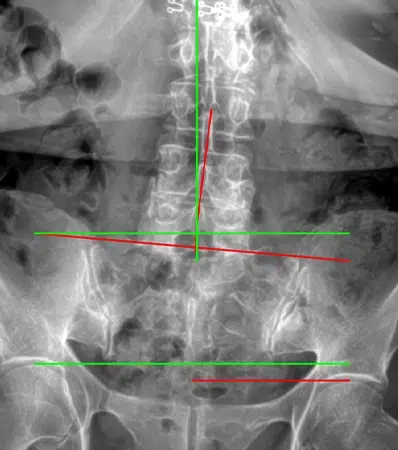
We are not guessing based on how your legs look while you lie on a table. We use imaging when needed because the plan changes if the issue is structural.
Your Feet May Be Driving Your Hip or Knee Pain
Your feet are the foundation for everything above them. If the arches collapse, the feet overpronate, or weight is distributed unevenly, that can affect how the knees track and how the hips absorb force.
That is why we use a digital foot scan to evaluate your arches and weight distribution. If your scan shows that your feet are contributing to the problem, custom orthotics may be recommended.
Orthotics are not for everyone. The point of the scan is to determine whether your feet are part of the problem and whether support would help improve the mechanics up the chain.
Research on foot orthoses for patellofemoral pain has found they improve knee function in some patients. A 2022 systematic review and meta-analysis found improvement in knee function and sport/recreation function. That is why we do not treat orthotics like a magic insert. We use them when the mechanics support it.
Common Hip and Knee Pain Problems We Evaluate
We help evaluate people dealing with:
- Knee arthritis symptoms
- Hip arthritis symptoms
- Pain going up or down stairs
- Pain when walking or standing
- Pain getting in or out of a chair or car
- Outside hip pain
- Kneecap pain
- Knee stiffness or swelling
- Tendon/ligament irritation around the hip or knee
- Pain that keeps coming back after rest or stretching
- Hip or knee pain that may be related to foot mechanics or a short leg
If your pain is severe, sudden, traumatic, or associated with major swelling, fever, numbness, loss of strength, or inability to bear weight, you should seek urgent medical evaluation.
Here Is How It Works
Step 1: Schedule a Consultation
We listen to what is happening, what you have already tried, and what you want to get back to doing.
Step 2: Find the Cause
We evaluate joint motion, foot mechanics, posture, movement patterns, and structural factors. When needed, we use imaging and the triangle method to rule out a structural short leg.
Step 3: Build Your Plan
Your plan may include SoftWave Therapy, extremity adjustments, custom orthotics, corrective care, or a combination based on your findings.
Step 4: Get Back to Moving Better
The goal is less pain, better mechanics, and more confidence using your hips and knees again.
A Different Kind of Hip and Knee Pain Care
Shift Health Center is not your traditional chiropractic office. We do not rely on twisting, cracking, or quick symptom chasing.
We look at structure, mechanics, and tissue health together. That matters because hip and knee pain is often bigger than the joint that hurts.
Our approach is built around a simple idea:
If we can reduce the stress causing the problem and help the damaged tissue heal, your body has a better chance to move the way it was designed to move.
Ready to Find Out Why Your Hip or Knee Hurts?
If hip or knee pain is keeping you from walking, exercising, golfing, working, or enjoying life the way you want, we can help you figure out what is going on.
Schedule a Hip and Knee Pain Consultation at Shift Health Center in Traverse City.
FAQ Section
Can SoftWave Therapy help knee pain?
SoftWave Therapy can help some knee pain cases by stimulating a healing response in irritated or damaged tissue. Research on extracorporeal shockwave therapy for knee osteoarthritis has found improvements in pain and function. Your exam determines whether SoftWave is appropriate for your case.
Can hip pain come from my feet?
Yes, it can. Poor foot mechanics can change how force travels through the knees, hips, pelvis, and low back. That is why we use a digital foot scan when we suspect the feet may be contributing to the problem.
Why would you X-ray my pelvis for hip or knee pain?
We may use an AP Modified Ferguson X-ray to evaluate pelvic structure and rule out a structural short leg using the triangle method. A leg length difference can change how your hips and knees absorb force.
Do I need custom orthotics?
Not everyone does. We recommend orthotics only when your foot scan and exam suggest your feet are contributing to the problem.
Are extremity adjustments just for temporary relief?
No. The purpose is to improve joint motion and mechanics. Better motion can help reduce compensation and abnormal stress on the painful area.
What makes Shift different?
We address both sides of the problem: the biomechanics causing abnormal stress and the tissue damage that has already occurred. That combination gives us a clearer plan than chasing symptoms alone.
Sources
- Avendaño-Coy J, et al. “Extracorporeal shockwave therapy improves pain and function in subjects with knee osteoarthritis: A systematic review and meta-analysis of randomized clinical trials.” International Journal of Surgery. 2020. PMID: 32798759. https://pubmed.ncbi.nlm.nih.gov/32798759/
- Rhim HC, et al. “Extracorporeal Shockwave Therapy for Greater Trochanteric Pain Syndrome: A Systematic Review with Meta-Analysis of Randomized Clinical Trials.” JBJS Reviews. 2024. PMID: 39297780. https://pubmed.ncbi.nlm.nih.gov/39297780/
- Murray KJ, et al. “Leg length discrepancy and osteoarthritis in the knee, hip and lumbar spine.” Journal of the Canadian Chiropractic Association. 2015. PMID: 26500356. PMCID: PMC4593034. https://pubmed.ncbi.nlm.nih.gov/26500356/
- Bonanno DR, et al. “Foot orthoses and physiotherapy in the treatment of patellofemoral pain syndrome: randomised clinical trial.” BMJ. 2008. https://www.bmj.com/content/337/bmj.a1735
- Wei Z, et al. “The effect of foot orthoses for patients with patellofemoral pain syndrome: A systematic review and meta-analysis.” Heliyon. 2022. https://www.sciencedirect.com/science/article/pii/S2405844022009446
- Tsokanos A, et al. “The Efficacy of Manual Therapy in Patients with Knee Osteoarthritis: A Systematic Review.” Medicina. 2021. PMCID: PMC8304320. https://pmc.ncbi.nlm.nih.gov/articles/PMC8304320/

OFFICE HOURS
Monday
10:00am - 1:00pm
3:00pm - 6:00pm
Tuesday
7:00am - 11:00am
Wednesday
10:00am - 1:00pm
3:00pm - 6:00pm
Thursday
8:00am - 12:00pm
2:00pm - 5:00pm
Friday
Closed
Saturday
Closed
Sunday
Closed

Shift Health Center
2400 Northern Visions Dr
Traverse City, MI 49684
P: (231) 846-8897
F: (231) 360-2100